
Google is tightening the eligibility requirements for gambling ads on its platform and plans to make major adjustments to the certification rules. According to a letter from Digital Marketing Commissioner Adriaan Dekker at risk on the British side, since 23 March, a website using a free website service or a third-party sub-domain name will not be able to obtain certification for gambling advertising.
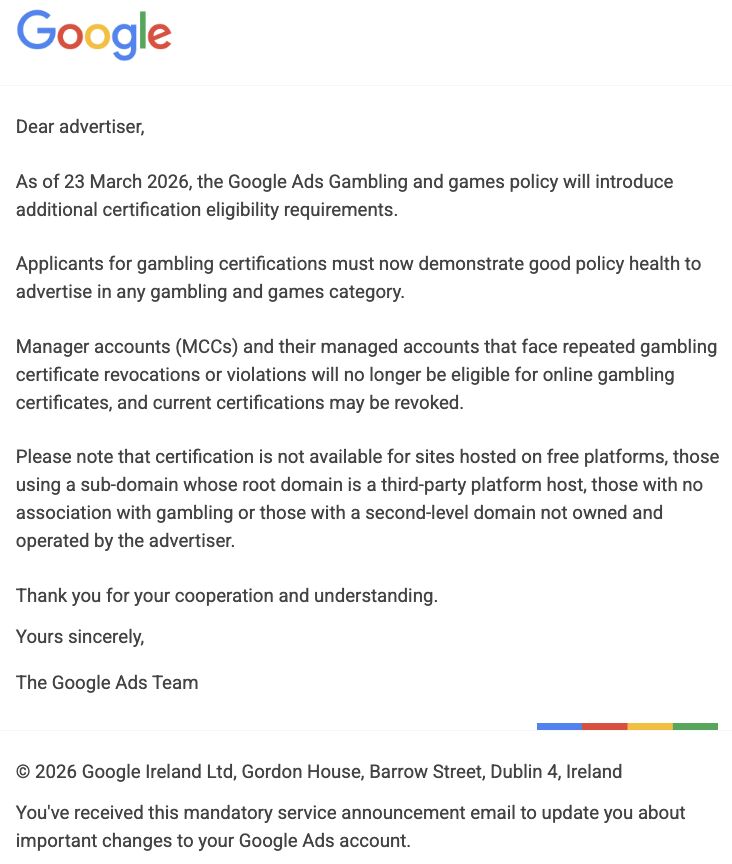
The new regulation requires that the advertiser applying for accreditation must have the main part of the site ‘ s address, i.e. a secondary domain name. In addition, websites that are “unsubstantially related” to gambling will not be able to obtain advertising certification for gambling services. This is intended to ensure that gambling sites are indeed run by advertisers, thereby reducing the exposure of fraudulent and misleading advertising on Google platforms. This adjustment to the Gambling and Game Policy was the most significant rule amendment after Google extended off-line gambling advertising restrictions to 35 countries. Companies will also be targeted in the light of recent developments in national regulatory frameworks, such as Google’s confirmation that its advertising policy in India has been adjusted following the ban on online gold games in India.
This is at a time when companies such as Google and Meta are facing increasingly stringent scrutiny because of the proliferation of advertising for illegal operators. Earlier this week, Tim Miller, Chief Executive Officer of the British Lottery Commission, publicly accused Meta of “opening one eye and one eye” on an operator outside the British self-prohibited gambling scheme GamStop. He refuted Meta’s claim that “uninformed, unmanageable”, arguing that Meta’s technical ability to use keyword tools on its own initiative to stop illegal gambling advertising was entirely possible. Previously, a Reuters survey revealed that Meta internally projected that about 10 per cent of its total revenue in 2024 (about $16 billion) was from fraudulent and contraband advertising. The leaking documents show that Meta has not been able to identify and stop “massive advertising” over the past three years, exposing billions of users on Facebook, Instagram and Whatsapp to “fraudier electricians and investment scams, illegal online casinos and prohibited medical products”. In response, the spokesperson for Meta argued that the report was “a one-sided distortion of Meta’s approach to fraud”.
While Google’s actions against potential illegal operators may to some extent curb the flow of unregulated advertising, a simple search for “non-GamStop operators” would still indicate that a large number of users are being directed to the coalition websites of such operators, indicating that Google still has a long way to go in combating illegal proliferation.