
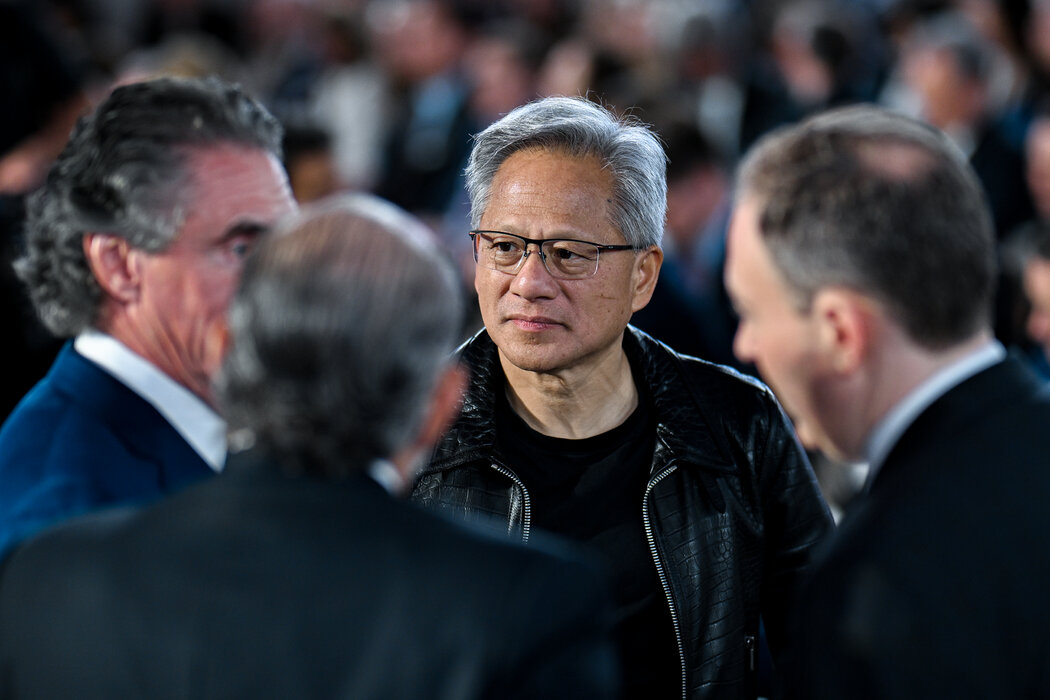
Chief Executive Officer Wong In-hoon, Young Weida, last month. Huang In-hoon and President Tripp reached a 15 per cent split at a White House meeting last week.
In Weida and AMD are expected to pay 15 per cent of their sales to the United States Government, as part of an unusual financial agreement with the Trump Government.
According to three sources, the agreement was reached one month after Ying Wei Da was authorized to sell a simplified version of the AI chip to China. Since they had no right to discuss the matter in public, the three requested anonymity.
Although the Trump government publicly announced a month ago that it had authorized Ying Wei Da to sell H20 to China, it did not actually issue a sales licence.
According to informed sources, CEO Hwang In-hoon of Inweida agreed to pay 15 per cent of the federal government ‘ s share of revenues when he met President Trump at the White House last Wednesday, which in essence made the federal government a partner in British Wida ‘ s operations in China. According to these sources, two days later, the Ministry of Commerce began issuing licences for the sale of artificial intelligence chips.
Although Huang In-hoon has been leading negotiations with the White House, In Weida is not the only company selling artificial intelligence chips to China. AMD is also selling an artificial intelligence chip called MI308, which was also banned from selling to China by the Trump government in April this year.
There is little precedent for the United States Department of Commerce to make the granting of export licences conditional on income sharing. This non-traditional pattern of payments, however, is consistent with Trump ‘ s growing role as an interlocutor in international commercial transactions of United States enterprises. In June this year, the Government approved a deal for the acquisition of United States Steel by Japanese iron and steel companies, which included the rare form of holding a share in a business that gave the Government a “gold share”.
The Trump Government is also using tariffs as a policy tool to bring manufacturing back to the United States. Last week, Trump indicated that 100 per cent tariffs would be imposed on semiconductors produced abroad unless technology enterprises invested in the United States.
The chip-sharing agreement reached last week is expected to generate over $2 billion in revenue for the United States Government. According to Bernstein Research, the sales of the H20 chips to China by the end of the year are expected to exceed $15 billion, while AMD is expected to achieve $800 million.
The United States Department of Commerce, the White House and AMD Sunday did not comment.